
visual production

Visual production is based on extensive software expertise and on the connection between digital image and physical body, enabling the creation of complex scenes through the combination of diverse techniques including video editing, 2D and 3D animation, 3D modeling, motion design, vector illustration, as well as reconstruction of footage.
Innovation in software is an important component of this work, as it can not only determine contemporary visual practice, but also impact the content, allowing new or more precise statements to emerge. A current focus lies on the latest software solutions for real-time photorealism in 3D using Unreal Engine, as well as on AI-assisted processes for 3D video production, including transferring physical body movements, captured with a camera, onto 3D models.

music visuals

>>>
I produce my music visuals by mixing different aesthetics and visual styles, by combining 3D animation, 2D motion design, self-filmed footage, found retro clips and video game sequences – layered and heavily post-processed with plugins.
Through such combinations, I try to find new ways of narration that determine the modern look of video art today.
bodybuilding

>>> Muscle gain is my artwork
Bodybuilding constitutes an integral part of the artistic practice.

In this context, weight training functions as a form of artistic research in which physical and cognitive processes are synchronized. Through repeated, controlled exertion, a stable tension emerges, along with a system of order, resilience, discipline, and self-determination.
This practice can be understood as a form of emancipation: it shifts the body from a state of reactivity toward active agency. States of tension—arising from biographical experience as well as from the perception of global crises, including the wars of recent years—are not suppressed but articulated through structured movement. In this sense, training operates as a counterforce to powerlessness, disintegration, and overload.
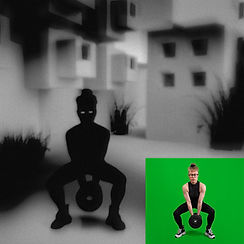


At the same time, physical processes are translated into visual work. First, training sequences are documented on video and further processed digitally. Second, recorded movements are transferred onto virtual 3D models and reconstructed within real-time environments (including the use of DIY motion capture technologies and AI-assisted processes for 3D animation). This establishes a link between physical experience and digital representation, in which the body functions both as medium and as point of departure for the artistic work.

Referring to muscle gain as artwork does not imply a metaphorical gesture, but rather a concrete, long-term vector: the construction of structure under conditions of external instability.
research
<WIP version>
At the core of the work is the investigation of complementary dynamics that emerge from the interaction of heterogeneous components. These include connections between different artistic disciplines, between physical and cognitive work, as well as between different personality structures — for example, between narcissistic traits and pronounced empathy, or between borderline organizations and neurodivergent conditions. Within specific, often fragile constellations, such interactions can generate productive and mutually reinforcing processes, as the respective components complement one another. At the same time, they carry the potential to shift into destructive dynamics, whose tipping point within the interaction is often difficult to identify, even though the consequences for all involved can be significant.
The current phase of the work is focused on conceptual development: the systematization and condensation of previously developed material, the elaboration of a structured script outline, and the further articulation of the artistic methodology. This methodology is based on the observation, analysis, and practical testing of complementary dynamics, as well as their translation into visual form. A central aspect of the work lies in the comparative examination of these dynamics across different domains — particularly in video art, physical practice, and research on personality structures (including DSM-5). The starting point is the observation that similar mechanisms of formation and transformation can be identified across these fields, although they have not yet been systematically articulated.

get in touch


modellogia [at] gmail.com
© 2016-2026 Modellogia
Friedrichshain-Kreuzberg
Berlin, Germany